
Behind the Scoop · October 9, 2026
Is a Pooper Scooper Business Worth Starting? What We've Learned From Running One
Is starting a pooper scooper business worth it? An experienced operator shares the advantages, challenges, and realities of running a pet waste removal company.
By Brent Winterton
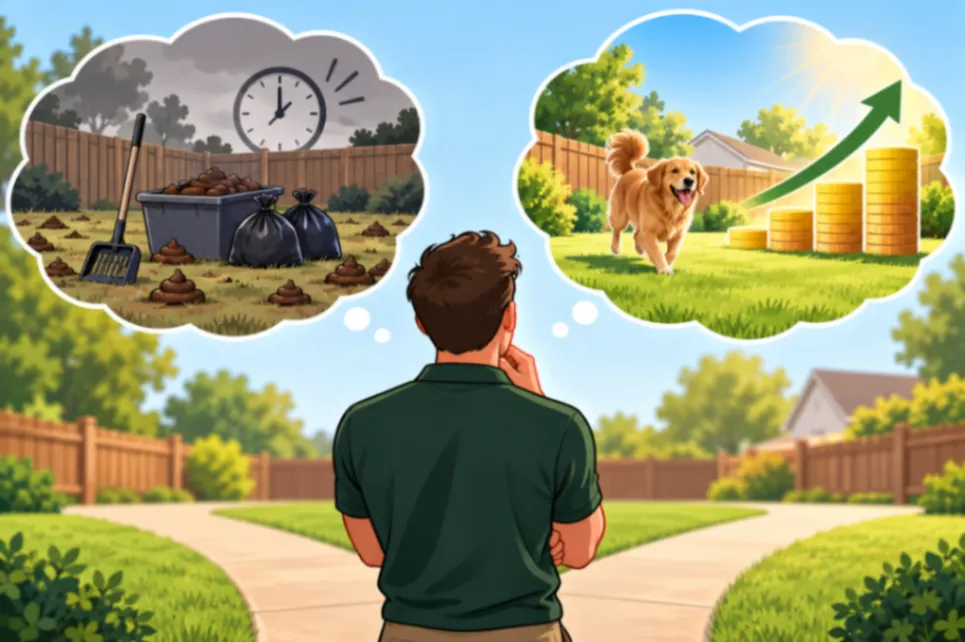
I’ve been involved in the pet waste removal industry long enough to see how differently people approach the idea of starting a pooper scooper business. Some see it as a relatively inexpensive way to become self-employed. Others are attracted to the recurring revenue, while some simply hear that people are making money picking up dog poop and want to know whether it’s actually legitimate.
I understand the appeal. Compared with many service businesses, there aren’t a lot of complicated equipment requirements, the service is easy to explain, and nearly every neighborhood has dog owners who could potentially become customers.
But after being involved in operating pet waste removal businesses, I think the more useful question isn’t whether you canmake money picking up dog poop. It’s whether the business model is a good fit for what you’re trying to accomplish.
There are some real advantages to the industry, but there are also challenges that tend to become obvious only after you’ve started acquiring customers.
The Recurring Revenue Is a Major Advantage
One of the things that makes the pooper scooper business model attractive is that the service naturally lends itself to recurring customers.
A homeowner who hires someone to clean their yard usually isn’t looking for a one-time solution. Their dog is going to continue producing waste, and many customers would prefer to have someone take care of it every week.
That means you’re not necessarily starting from zero at the beginning of every month. If you have a base of recurring customers, you have an opportunity to generate revenue from those same customers repeatedly.
Of course, that doesn’t mean every customer stays forever. People move, change their budgets, or decide they no longer need the service. But compared with a business that relies entirely on one-time jobs, recurring pet waste removal has some attractive characteristics.
It’s one of the reasons the industry has continued to interest me as a business owner.
It’s Relatively Simple to Start, but Not Necessarily Easy to Grow
When someone asks whether starting a pooper scooper business is worth it, I think it’s important to separate the startup process from the work required to build a successful company.
You don’t need a large amount of specialized machinery to clean a backyard. Basic scooping equipment, reliable transportation, and an appropriate business setup can be enough to begin providing the service.
That simplicity is appealing, especially for someone who doesn’t have a large amount of capital available.
However, getting your first customers and building efficient routes can be more challenging than the physical work itself.
You have to convince homeowners to pay for something many of them have always done themselves. You need to figure out pricing, advertising, customer communication, and how to organize customers geographically.
Those are the same kinds of business challenges you’d encounter in many other home-service industries.
The fact that the service involves picking up dog poop doesn’t eliminate them.
Customer Location Has a Huge Effect on the Business
One of the biggest lessons I’ve learned from operating in this industry is that customer count doesn’t tell you nearly as much as people think.
Two pooper scooper companies might each have 100 recurring customers, but their routes could look completely different.
One company might have most of its customers concentrated in a relatively small area. The other might have customers scattered across an entire metropolitan region.
Even if both companies charge the same amount, the second business may spend significantly more time and money driving between properties.
That’s why I think route density deserves more attention from people considering starting a dog poop removal business.
In the beginning, it’s tempting to accept anyone willing to sign up. When you’re trying to generate revenue, a customer twenty minutes outside your service area can still feel like a win.
But as your schedule fills up, those decisions start affecting how many yards you can realistically service in a day.
You Need to Be Comfortable With Customer Service
Most people focus on the scooping when they imagine running a pet waste removal company, but customer communication becomes a substantial part of the job.
People request quotes, ask questions, change their service schedules, get additional dogs, move, pause service, and occasionally cancel.
You also have to deal with billing issues, locked gates, weather delays, and customer complaints.
None of these things is particularly unusual for a service business, but they can surprise someone who thought the job would mostly involve working independently outdoors.
As the company grows, having good customer management systems becomes increasingly important.
We’ve found enough value in that side of the industry that we’ve also become involved in HomeFlow Suite, which focuses on automating lead follow-up, customer reactivation, and other repetitive communication for service businesses.
Hiring Employees Changes Your Responsibilities
There’s a significant difference between running a solo pooper scooper business and building a company with employees.
When you’re cleaning every yard yourself, you know exactly how the work is being performed. You also know which customers have special requests and which properties take longer than expected.
Once you hire technicians, you have to create processes that allow other people to provide consistent service.
That includes training, scheduling, payroll, customer notes, and making sure the work is completed properly.
You also need to think more carefully about the economics of each route because you’re now paying someone else to perform the physical work.
A business that produces a reasonable income while the owner performs all the labor may look very different once employee wages are included.
So, Is a Pooper Scooper Business Worth It?
I think it can be, particularly for someone who wants to build a local service company and is willing to learn the business side of the industry.
The recurring revenue model is attractive, the equipment requirements are relatively modest, and there are opportunities to grow beyond a one-person operation.
But I wouldn’t recommend going into it expecting easy money.
Acquiring customers takes work, route efficiency matters, and growing a company introduces responsibilities that have little to do with scooping.
If you’re considering getting into the industry, I’d spend just as much time learning about customer acquisition, pricing, and route management as you do researching equipment.
For people who want to explore those subjects in more detail, Poop Scoop Academy provides education and resources specifically for starting and growing a pet waste removal business.
And for homeowners who would rather hire a company than pick up dog poop themselves, Scooping R Us provides professional pet waste removal services.